Natural Materials · Mattress Construction
Obasan Latex Layers: How Construction Shapes Comfort and Support
A latex mattress is more than a single material in a handsome cover. Its character emerges from the considered arrangement of layers: how thick they are, how firm they feel, and how they work together beneath the sleeper. Understanding that architecture offers a more useful way to compare natural latex sleep surfaces—and a clearer path toward finding one that feels right.
In the language of interiors, a mattress is a hidden foundation. It is rarely the most visible part of a room, yet its construction determines much of the experience of inhabiting that room after dark. With natural latex, the details beneath the surface matter enormously. A firm core beneath a more yielding comfort layer can feel quite different from a uniform block of latex, even when both mattresses share similar materials.
Obasan’s natural latex category provides a useful lens for considering these distinctions. Rather than treating “latex” as a complete description, compare the arrangement of the layers, their individual firmness, and the overall design. Those factors can influence how a sleep surface responds to weight, how readily it cushions pressure points, and whether its feel is buoyant, closely conforming, or somewhere between the two.
This is not a promise that one construction will suit every sleeper. Comfort is personal, and terms such as “medium” or “supportive” can be interpreted differently from one person to another. But a little fluency in mattress construction can transform comparison from a search through adjectives into a practical examination of materials and design.
Start with the architecture, not the label
Mattress descriptions often lead with a firmness rating or a broad material claim. Both can be useful, but neither tells the whole story. A layered latex mattress is a small system: each component has a role, and the combined effect depends on how those components are stacked and enclosed.
A typical design may use a denser base layer to provide structure, with one or more softer layers above it to create a more welcoming first impression. The core is meant to resist excessive compression and create a stable foundation. The upper layers are intended to moderate that firmness, allowing the body to settle into the surface with a sense of cushioning. In a thoughtfully balanced design, the transition between these sensations feels coherent rather than abrupt.
Layering can also make a mattress more adjustable. Some systems allow layers to be rearranged or exchanged, while others are built as a fixed, zipped assembly. A customizable arrangement offers the possibility of changing the feel without replacing the entire mattress, although the practical value depends on the available layer choices, the terms of the system, and whether the sleeper is comfortable making adjustments.
When considering an Obasan mattress—or any natural latex option—look beyond the total number of layers. Ask what each layer is intended to do, whether its firmness is specified, how thick it is, and whether the design allows modification. The answers are more revealing than a dramatic description of how a mattress is supposed to feel.
Thickness changes the conversation
Layer thickness influences how a mattress feels, but it does not work in isolation. A thicker soft layer may offer a more pronounced cushion before the sleeper encounters the firmer materials beneath it. A thinner comfort layer can create a closer, more immediate connection to the supportive core. Yet the result also depends on latex firmness, the sleeper’s body and preferred position, and the mattress’s complete construction.
Consider two hypothetical designs. One places a modest layer of softer latex above a firm base. The surface may feel responsive and relatively level, with a noticeable sense of support close to the body. Another uses a deeper comfort layer over a similar core. It may create more initial give and a more enveloping impression. Neither description establishes which is better; it simply identifies a difference worth evaluating.
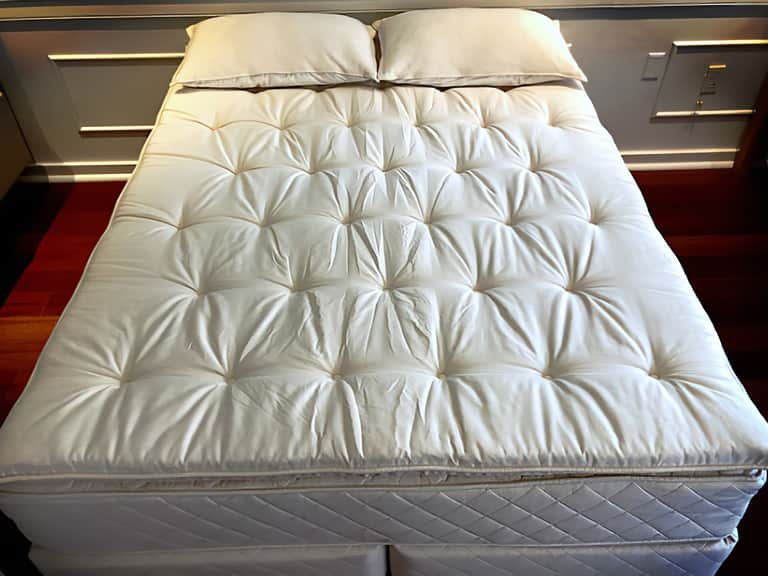
Thickness is especially relevant when a mattress includes a separate topper. A topper can soften or refresh the feel of a sleep surface, but it is not always equivalent to a comfort layer integrated into the mattress. It may move independently, add height, or alter how the body meets the underlying construction. Before choosing a design with an added topper, consider whether you want a distinct cushioning layer and how it will affect your fitted sheets, bed height, and overall support experience.
It is also wise to verify dimensions carefully. A mattress’s stated height may refer to the core alone or to the complete assembly, including a topper. When comparing construction, use like-for-like measurements and check whether a removable cover, foundation, or accessory is included in the quoted total.
Firmness is a layered sensation
Firmness is often presented as though it were an objective, universal scale. In practice, the sensation is shaped by the full mattress and the person sleeping on it. Body weight, proportions, preferred sleeping position, and individual comfort preferences all influence how much a layer compresses and how supportive the surface feels.
A mattress described as medium-firm may feel reassuringly stable to one sleeper and too yielding to another. A softer top layer does not necessarily mean the entire mattress lacks support; a well-designed firm core can provide structure underneath a more cushioned surface. Conversely, a firm core alone does not guarantee a comfortable experience if the upper layers do not offer the kind of pressure relief the sleeper prefers.
Think of firmness in terms of two related questions. First, what do you feel when you lie down—the initial softness or resistance at the surface? Second, what happens after your weight settles: does the mattress continue to feel stable, or does it seem to give way more than you would like? The first response is often associated with the comfort layers; the second reflects the combined behavior of the full construction.
Side sleepers commonly pay close attention to cushioning at the shoulder and hip, while back and stomach sleepers may prioritize a surface that feels more level to them. These are useful starting points, not rigid rules. Individual anatomy and preference vary, and mattress descriptions cannot diagnose or treat pain. If persistent discomfort is a concern, seek advice from an appropriate health professional rather than relying on bedding changes alone.
The responsive character of latex
Natural latex is often valued for its springy, resilient response. Rather than sinking slowly and remaining deeply contoured, latex generally pushes back as pressure is applied. The precise sensation changes with the formulation, firmness, thickness, and construction, but many sleepers describe latex as buoyant or lively compared with more slowly responding foams.
That resilience has a practical consequence: the surface can feel easier to move across. Some people enjoy this sense of lift and freedom; others prefer a more gradual, close-fitting contour. Neither preference is more sophisticated or correct. The question is whether the mattress’s response feels comfortable to you through the night, including when you change positions.
Layer arrangement helps tune that response. A firmer base can anchor the mattress, while softer upper layers offer a less forceful first impression. Multiple layers may create a more nuanced progression from surface cushioning to underlying support. A single, consistent latex layer may instead provide a simpler, more uniform feel. Product descriptions should explain enough about the construction to make this comparison possible; when they do not, ask the seller for a clear layer-by-layer specification.
Breathability is another part of the broader material conversation. Latex, cotton, and wool are often used together in natural mattress designs, each bringing different characteristics to the finished product. A cover and quilted materials can affect the feel of the sleep surface, while wool may be selected for its moisture-management and temperature-related properties. These qualities depend on the specific construction and should not be mistaken for a guarantee that every sleeper will sleep cool in every room.
What the material profile can—and cannot—tell you
For readers drawn to sustainable or natural materials, the bill of materials deserves the same attention as the comfort description. “Natural latex” can appear in a product story alongside cotton, wool, or other components, but clear disclosure matters. Look for the type of latex, the materials used in each layer, the cover composition, and relevant certifications. A certification applies to particular materials or production standards; it should not be interpreted as a blanket guarantee of comfort, medical benefit, or environmental perfection.
Terms such as organic, natural, and eco-friendly can be meaningful only when readers can understand what they refer to. Check which component is certified, which organization issued the certification, and whether the claim relates to raw materials, processing, or the finished product. A transparent description makes it easier to distinguish a mattress built around documented material choices from one relying mostly on broad language.
Construction also affects care. Latex mattresses and toppers may have particular cleaning instructions, and some covers are designed to be spot-cleaned rather than removed and washed. Follow the manufacturer’s care guidance, protect the surface with an appropriately sized protector if desired, and confirm the foundation requirements before setup. A supportive mattress can still perform poorly if placed on an unsuitable base or used contrary to its care instructions.
For a related example of how layer descriptions can be made concrete, the Naturally Organic Hudson Luxe Latex Mattress is described as having a five-inch firm organic Dunlop latex core, a three-inch medium latex layer, and an additional topper made with latex and wool. This is a separate product, not an Obasan model, but it illustrates why layer-by-layer detail is valuable: shoppers can see how the core and comfort components are intended to work together rather than relying on a single firmness label.
A thoughtful way to compare Obasan latex options
When comparing models in Obasan’s natural latex range, approach each description as a set of practical questions. Begin with the composition: what is the latex type, and what other materials appear in the mattress? Then map the construction from the surface down. Note layer thicknesses, firmness descriptions, whether the layers are fixed or adjustable, and how the cover is built.
Next, translate the specifications into the sensation you are seeking. If you enjoy a more cushioned surface, determine which layer provides that feel and how deep it is. If you prefer a more immediate, stable response, look at the firmness and thickness of the upper layers as well as the core. If you are unsure, compare the maker’s descriptions with your experience on mattresses you have already used—while remembering that a familiar mattress may have changed over time.
Finally, assess the practical details that remain important after the first night. Confirm the total height, foundation compatibility, return or exchange terms, warranty conditions, and delivery arrangements. Find out whether any layer changes are possible and what they involve. These points are less romantic than the promise of a perfect night, but they are part of a considered purchase and can help prevent surprises.
- Map the layers: identify the core, comfort layers, cover, and any separate topper.
- Compare specifications: note thickness and firmness descriptions for each component, not only the mattress overall.
- Check adjustability: establish whether layers can be rearranged or replaced and whether changes carry additional costs.
- Read material claims carefully: identify which components are certified and what each certification covers.
- Review care and setup: confirm cleaning instructions, foundation requirements, mattress height, and return terms.
- Center your own preferences: use sleep position as one consideration among several, not as a rule that dictates a single firmness.
A natural mattress is a personal composition
The appeal of latex lies partly in its material story and partly in the sensation created by its construction. A carefully arranged set of layers can balance a supportive foundation with a softer welcome, while the cover and accompanying fibers complete the experience. But there is no universal formula. What feels generous to one sleeper may feel too plush to another; what feels buoyant to one person may feel unfamiliar to someone accustomed to a slower-responding surface.
That is why the most useful question is not simply, “Is this mattress natural latex?” It is, “How is the latex arranged, what does each layer contribute, and does that construction match the way I want a bed to feel?” In the case of Obasan latex sleep surfaces, attention to layer design, thickness, firmness, and material disclosure provides a grounded way to explore the range without assuming every configuration suits everyone.
Mattress shopping benefits from restraint. Take time to compare specifications, distinguish material claims from comfort claims, and read the terms as closely as the headline. A clear understanding of construction will not make personal preference entirely predictable, but it can make the decision more informed. In a category where comfort is often described in sweeping language, the quiet precision of a layer-by-layer account can be the most useful detail of all.
Frequently asked questions
Do more latex layers automatically mean greater comfort?
No. More layers create additional opportunities to combine different feels, but the result depends on the latex firmness, thickness, materials, and how the layers work together. A simpler construction may suit someone who prefers a more consistent surface.
Does a thicker comfort layer always feel softer?
Not necessarily. Thickness can affect how much cushioning is present before the firmer layers underneath are felt, but firmness and the complete mattress design also matter. Descriptions are useful guides, not substitutes for individual comfort preferences.
Is natural latex the same as organic latex?
The terms are not interchangeable. “Natural latex” describes a material category, while an organic claim should be supported by relevant certification and clearly identify which components qualify. Review the product’s material disclosures and certification details rather than relying on a general label.
What is the most important construction detail to compare?
Begin with the full layer arrangement: material, thickness, and stated firmness from top to bottom. Then consider the cover, any topper, adjustability, care requirements, and the foundation. Together, these details offer a more complete picture than a single firmness rating.