Organic Sleep & Nursery Guide
Choosing an Organic Crib Sleep Surface: Materials, Firmness, and Care
A thoughtful nursery begins with the essentials: a correctly sized, firm, flat crib mattress and a clear understanding of what it is made from. Organic cotton, wool, latex, and coconut fiber each bring different qualities to a sleep surface, but no material label can replace careful attention to fit, construction, safety guidance, and everyday care.
Published November 7, 2026
Begin with the sleep space, not the label
Shopping for an organic crib mattress can feel like a study in vocabulary: certified cotton, natural wool, latex, coconut coir, breathable panels, waterproof barriers, and two-stage construction. These descriptions can help explain a product’s materials and design, but they should not obscure the first questions caregivers need to answer. Does the mattress fit the crib it will be used in? Is its surface firm and flat? Can its cover and components be cared for as the manufacturer directs? And do the product instructions match the child’s age and stage?
Organic describes a sourcing or production standard for particular materials. It is not, by itself, a complete measure of infant sleep safety, mattress performance, or suitability for every family. A beautifully considered material story matters most when it sits alongside clear specifications and appropriate use instructions.
For safe-sleep guidance, caregivers should consult current recommendations from recognized public health authorities, including the American Academy of Pediatrics, and follow the laws and standards applicable where they live. This article is an educational overview, not medical advice or a substitute for a product’s instructions.
Firmness and fit are non-negotiable starting points
A crib sleep surface should be firm and flat, with a fitted sheet designed for that mattress. “Firm” is not a judgment about adult comfort; it describes the supportive feel recommended for an infant sleep surface. Plush quilting, soft toppers, loose padding, and accessories that change the surface may affect its intended use. Unless specifically permitted by the mattress manufacturer and consistent with current safe-sleep guidance, avoid adding a separate topper or pad to an infant’s sleep space.
Fit is equally practical and important. A mattress made for a standard-size crib may not fit every crib, portable crib, or bassinet. Check the crib and mattress manuals, the stated dimensions, and any applicable fit instructions rather than relying on a size name alone. The mattress should sit securely in the crib without an unsuitable gap at the edges. If the mattress shifts, buckles, or leaves a noticeable space, pause use and contact the manufacturer for guidance.
Also verify mattress height and thickness against the crib’s limits. A product can be described as a crib mattress yet still have dimensions or features that are incompatible with a particular crib. Keep packaging and product details available after purchase; they can help with care questions, warranty support, and any safety notices.
- Confirm that the mattress is approved for the exact crib or sleep product in use.
- Check dimensions and fit instructions in both product manuals.
- Look for a level, supportive surface and use only a fitted sheet intended to fit it.
- Follow the manufacturer’s age, weight, side-selection, and use directions where applicable.
Organic cotton: familiar, breathable, and versatile
Organic cotton often appears in a crib mattress cover, a quilted pad, or an inner layer. It is valued for its soft hand and familiar feel, and it can be woven or knitted in different ways. Percale, sateen, canvas, and jersey, for example, describe different textile constructions rather than a guarantee of a particular mattress firmness or performance.
When assessing cotton, distinguish the material itself from the construction around it. Is the cotton used in the outer fabric, the filling, or both? Is it quilted, layered, or blended with another fiber? Is the cover removable, or should it remain in place? Those details affect cleaning and maintenance. A cotton cover may be pleasant to handle, but it does not automatically make a mattress waterproof or washable.
Organic claims also deserve specificity. A certification such as GOTS relates to defined requirements for organic fibers and processing within its scope. Check which component is certified and whether the certification applies to the finished product or only a stated material. Labels and marketing language can use similar-sounding terms while referring to different parts of an item. Reading the certification details is more useful than assuming that “organic” describes every component equally.
Natural fibers can change with use and washing. Cotton may shrink, wrinkle, or become less smooth after laundering, depending on how it is made and cared for. Follow the care label rather than applying a general bedding routine to a mattress component that may have different instructions.
Wool: a material with distinctive care needs
Wool is used in some crib mattresses as batting or as part of a layered construction. It is often selected for its moisture-managing and temperature-regulating characteristics, and certain manufacturers use it as part of a fire-barrier design. These are material and construction considerations, not a reason to assume that every wool-containing product has the same performance or approvals.
Ask how the wool is used and what role the manufacturer assigns to it. Is it inside the mattress, quilted into a layer, or present in a separate topper? Is it certified, and what standard does that certification cover? What does the manufacturer say about flame-resistance requirements and the finished product? A material description alone cannot answer every regulatory or safety question; look for product-specific documentation and follow the instructions supplied with the mattress.
Wool also calls for particular care. Some wool-filled products are intended for spot cleaning or periodic airing rather than machine washing. A wet or improperly dried component may be damaged, and forceful washing can alter its shape or distribution. If an accident occurs, consult the exact care instructions before using water, detergent, heat, or a cleaning device. Do not assume that a removable cover makes the internal mattress washable.
Latex and coconut fiber: understand the construction
Latex and coconut fiber, sometimes called coir, are used in some natural-material crib mattresses. Their presence can tell you something about the product’s composition, but not enough on its own to determine firmness, durability, or suitability. Latex may serve as a resilient core or one component of a layered design. Coconut fiber may be used as a structural layer, sometimes alongside cotton, wool, or latex.
For latex, check whether the product specifies natural, synthetic, or blended latex, and look for any relevant certification claims. Terms such as “natural” can be broad, so clear material breakdowns are helpful. If a child has a known allergy or a family has a concern about a material, discuss the situation with a qualified clinician and contact the manufacturer for precise component information. A label should not be treated as a substitute for individual medical guidance.
For coconut fiber, look at how it is bonded, layered, or covered, and whether the manufacturer explains the material’s role in the mattress. The fiber name alone does not establish that the sleep surface is firm, flat, or compatible with a particular crib. The finished construction and its specifications matter more than a single ingredient.
In either case, review the complete materials list, care guidance, and product instructions. A crib mattress is a system of layers and coverings; one natural component does not define the entire product.
How to read certifications without overreading them
Certifications can make material claims easier to assess, but each one has a defined scope. GOTS, for example, is associated with organic textile processing and related requirements. GOLS is used for organic latex claims. Other certifications may address emissions, chemical content, or a particular input. The meaningful question is not simply whether a product displays a badge, but what material or process that badge covers.
Before relying on a certification, check the certifier’s current public information and look for details such as the certificate holder, product scope, and validity. A certified cover does not necessarily mean every internal component is certified. Likewise, a standard that addresses one category of concern should not be interpreted as a guarantee of all possible safety, health, or environmental outcomes.
It is also useful to separate certification from compliance. A certification can provide information about specific claims, while applicable safety requirements and product regulations are separate matters. Ask the manufacturer for the exact model’s documentation if a listing is vague. A transparent maker should be able to explain the materials, relevant testing or compliance information, and the care limits without relying on sweeping claims such as “chemical-free” or “completely safe.”
Two-stage designs and changing needs
Some crib mattresses are described as two-stage or dual-sided, with one side intended for infant use and another designed for toddler use. The concept can extend the useful life of a product, but caregivers should never infer which side to use from appearance or softness alone. Follow the manufacturer’s age and stage instructions, and confirm that the crib and mattress remain compatible throughout the transition.
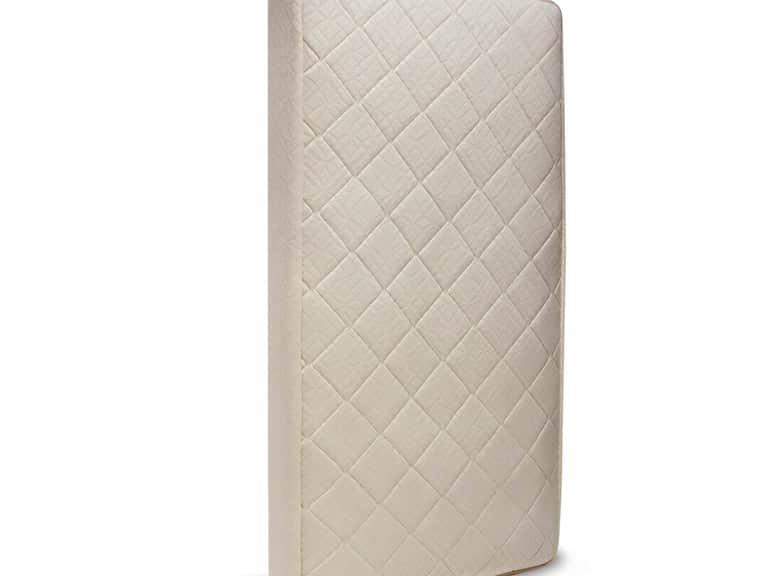
One example is the Naturepedic Ultra Breathable 2-Stage Organic Crib Mattress. Its product information describes a firm, flat supportive side for infant use and a cushion-firm side intended for toddler use, along with an included breathable mattress pad and a waterproof outer surface. The listing also describes organic cotton construction and a lightweight version. Caregivers should review the manufacturer’s full specifications, current instructions, and crib fit requirements before deciding whether it suits their nursery. A product description is not a substitute for those documents or for current safe-sleep recommendations.
Even when a design is intended to serve more than one stage, the child’s development and the manufacturer’s directions govern its use. Do not turn or reconfigure a mattress early because one surface seems more comfortable, and do not add accessories that change its intended firmness or shape.
Care, cleaning, and the everyday reality of a nursery
Care instructions are part of choosing a mattress, not fine print to discover after the first spill. A waterproof surface may be designed to wipe clean, while a breathable cover, wool layer, or quilted cotton pad may have stricter limits. Some covers are not removable. Others may be washable only in cold water, on a gentle cycle, or at a specified temperature. Heat, bleach, fabric softener, vigorous agitation, or an unsuitable cleaner can damage materials or affect the product’s fit.
Before the first use, check whether the manufacturer recommends airing, washing a removable component, or using the mattress as delivered. Do not wash an internal mattress core unless the instructions explicitly permit it. If moisture reaches a layer that cannot be cleaned or dried as directed, ask the manufacturer what to do rather than sealing it beneath bedding.
Use the fitted sheet specified for the mattress and keep the sleep surface clear of loose bedding and soft objects in accordance with current safe-sleep guidance. A protector or pad should be used only if it is compatible with the mattress, securely fitted, and allowed by both the mattress manufacturer and relevant guidance. “Organic” does not make an extra layer automatically appropriate.
Inspect the mattress periodically for changes such as broken seams, damaged waterproofing, a distorted surface, or components that no longer fit as intended. Check warranty terms and care exclusions, too. A warranty may not cover damage caused by high heat, bleach, excessive shrinkage, or improper cleaning. When in doubt, keep the product dry, avoid improvised repairs, and contact the manufacturer.
A considered nursery checklist
It can help to compare options in a simple, consistent way rather than letting a single feature dominate the decision. Note the following for each model:
- Dimensions and fit: Does the mattress fit the exact crib, and do the two manufacturers’ instructions agree?
- Firmness and shape: Is the surface described as firm and flat for infant use, with no unapproved soft topper or cushion?
- Materials: Which fibers and components are used in the cover, filling, core, and barrier?
- Certification scope: Which specific materials or processes are covered by each certification?
- Age and stage: If the mattress is reversible, are the sides and transition points clearly explained?
- Cleaning: Can the surface be wiped, does a cover come off, and what are the exact limits on washing and drying?
- Documentation: Are instructions, warranty information, and product-specific safety details easy to find?
This approach keeps the choice grounded in practical use. A clear, straightforward mattress may be a better match for a household than a more elaborate design whose care requirements or fit are uncertain.
Common questions about organic crib sleep surfaces
Does an organic crib mattress automatically mean a safer mattress?
No. “Organic” describes particular sourcing or processing claims, depending on the material and certification. It does not, by itself, establish correct fit, firmness, compliance, or suitability for a given crib. Review the complete product information and follow current safe-sleep guidance.
Is a breathable mattress the same as a safe sleep surface?
Not necessarily. “Breathable” can refer to a design feature or construction, and the meaning varies by product. It should not be treated as permission to use loose bedding, alter the sleep space, or disregard instructions. Evaluate the full mattress and use it as directed.
Can a crib mattress pad improve comfort?
A pad may be marketed as a protective or cushioning layer, but any added layer changes the sleep surface. For infant use, check current safe-sleep recommendations and confirm that the pad is explicitly suitable for the mattress and use. Do not add a soft topper or accessory unless its use is clearly permitted and consistent with authoritative guidance.
How can I tell whether a certification applies to the whole mattress?
Read the certificate and product documentation rather than relying on a badge alone. Look for the named product, material, and scope. If the listing does not make this clear, ask the manufacturer or verify the claim with the certifying organization.
A quieter, clearer way to choose
Organic crib sleep surfaces invite a closer look at what lies beneath the fabric: the fiber, the core, the barrier, and the way each piece is assembled. Cotton, wool, latex, and coconut fiber can all appear in thoughtful designs, but none should be judged by name alone. Firmness, fit, age-appropriate use, transparent certification details, and manageable care instructions belong in the same conversation.
The most considered choice is the one that fits the crib correctly, meets the family’s practical needs, and comes with clear instructions that caregivers can follow confidently. Start with the essentials, verify the details, and let material preferences guide the decision only after the fundamentals are in place.